
India’s solar industry is entering a decisive phase. After a decade focused on capacity expansion and cost reduction, the conversation is shifting to
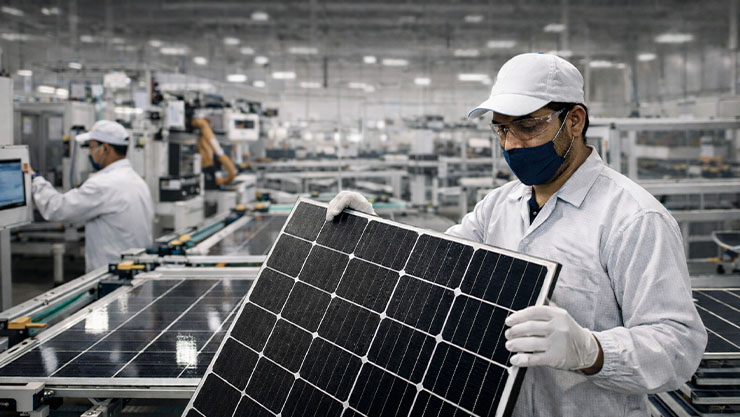
India’s solar industry is entering a decisive phase. After a decade focused on capacity expansion and cost reduction, the conversation is shifting toward performance at scale.
At the center of this transition is one clear direction — high-wattage solar modules.
Manufacturers like SOVA Solar, with nearly two decades of experience in module engineering and production, are already aligning their technology roadmaps to this shift. As India accelerates toward its 2030 renewable targets, 2026 is emerging as the year when 600W+ modules become the industry standard, particularly for industrial and utility-scale projects.
This is not a trend India should simply adopt. It is one India must actively shape.
Why the Industry Is Moving Beyond 500W
For much of the last decade, modules in the 450W–550W range dominated the market. That benchmark is now being redefined.
Large-scale solar projects today face three structural pressures — rising land costs, increasing BOS expenses, and tighter execution timelines. Higher-wattage modules directly address these challenges by reducing module count per megawatt, lowering structural and cabling requirements, and improving installation efficiency.
Manufacturers such as SOVA Solar, which focus on system-level optimization rather than headline wattage alone, are designing modules that help EPCs and developers improve overall project economics. For industrial rooftops, higher wattage allows greater energy density without expanding footprint. For utility-scale installations, it improves land utilization and reduces lifecycle costs.
High wattage is no longer about peak power. It is about efficiency across the entire solar system.
TOPCon and Large-Format Wafers Are Redefining Performance Standards
The rise of TOPCon cell architecture combined with large-format wafers like G12 and G12R is fundamentally changing module design.
TOPCon technology offers lower degradation, better temperature coefficients, and superior performance under low-light conditions — advantages that are particularly relevant for Indian operating environments. When paired with large-format wafers, manufacturers can consistently deliver 600W+ modules without compromising durability or long-term reliability.
SOVA Solar’s focus on TOPCon-based high-wattage platforms reflects this industry-wide shift, where performance stability over 25+ years is becoming more critical than incremental efficiency gains on paper.
The question facing manufacturers today is not whether to adopt TOPCon, but how responsibly and reliably it can be scaled.
How Higher Wattage Improves BOS and Land Economics
One of the most significant advantages of high-wattage modules lies beyond the module itself.
Fewer modules per megawatt translate into:
- Reduced mounting structures and steel consumption
- Shorter DC cable runs and fewer junction points
- Faster installation timelines
- Simplified operations and maintenance
For EPCs and asset owners, this results in lower capital expenditure per MW and improved project returns. For industrial installations with limited space, high-wattage modules allow meaningful capacity deployment without structural expansion.
Manufacturers like SOVA Solar, which design modules with BOS optimization in mind, are helping the industry move toward more efficient, scalable solar infrastructure.
Why Indian Manufacturers Must Lead This Transition
India’s solar manufacturing ecosystem has matured rapidly. Capacity has increased, quality benchmarks have strengthened, and technology adoption has accelerated.
The next phase requires leadership.
Companies such as SOVA Solar, with deep manufacturing roots and a long-term investment outlook, are well positioned to drive this transition — not by chasing global trends, but by building technology platforms suited to Indian conditions and global expectations.
By investing early in high-wattage module formats, advanced cell architectures, and precision manufacturing, Indian manufacturers can define the next generation of solar standards rather than follow them.
This leadership is essential for India’s ambition to emerge as a global solar manufacturing hub.
Looking Ahead to 2026
As EPCs redesign system architectures and developers optimize for scale, 600W+ modules will increasingly become the default choice for serious solar infrastructure.
For manufacturers like SOVA Solar, the shift toward high-wattage platforms is part of a broader commitment to engineering-led growth, long-term reliability, and responsible scaling.
2026 will not simply be remembered as another year of capacity addition.
It will mark the point where solar manufacturing, system efficiency, and national energy strategy aligned.
High-wattage modules will be at the center of that alignment — and manufacturers prepared for this shift will define the next decade of India’s solar journey.
COMMENTS