
The 76-year-old engineer behind NasalGuard® warns that India’s toxic air is no longer just a capital-city crisis but a nationwide condition, from Punjab’s towns to Uttar Pradesh’s cities, demanding a daily habit of awareness, wherever you live.
When India celebrated Diwali on November 8, Delhi dominated the headlines with an average AQI of 376 in the “very poor” category, while 20 stations hit “severe” by 10 pm. Yet by 11 pm, Delhi ranked fourth of 285 cities nationwide, behind Mandi Gobindgarh, Khora, and Ballabhgarh.
By morning, the toxic haze blanketed regions far beyond the capital, placing cities from Uttar Pradesh down to Chennai in “very poor” or “poor” brackets.
For Delhi-born inventor Ashok Wahi, who left for New York at 24, this widespread smog is the core issue. Having spent decades focused on preventing health harm before it begins, Wahi stresses that pollution can no longer be treated as a localised winter problem.
“Every year we talk about Delhi, and Delhi deserves the attention,” Wahi said. “But look at the map this Diwali. Towns in Punjab, cities in Uttar Pradesh, Pune, Ahmedabad, and Chennai. This is not a Delhi problem anymore. It is an Indian problem, and it lasts far longer than one night.”
A national condition, not a festival event
India’s air pollution extends far beyond a single holiday. IQAir’s 2025 World Air Quality Report ranked India as the sixth most polluted among 143 countries, with an average PM2.5 concentration about ten times the WHO guideline and 66 of the world’s 100 most polluted cities located within its borders. Despite safeguards like the Graded Response Action Plan and green firecracker limits, Delhi’s air has historically worsened the day after Diwali in eight of the past nine years. Vehicles, dust and still winter air, not just fireworks, drive this crisis. As inventor Ashok Wahi notes, the festival lasts one night, but the traffic, dust, and winter smog plague dozens of cities for months.
A career spent upstream
Wahi has tackled health challenges this way for decades. When his daughter Aikta once returned from a friend’s house with an allergic reaction to a cat, the antihistamine that eased her symptoms left her drowsy in class. Refusing to accept that trade-off, Wahi set out to keep allergens from reaching her at all. After dozens of failed attempts, he created NasalGuard®, a drug-free gel with a positively charged polymer that creates a faint electrostatic field around the nostrils to trap airborne particles before inhalation. Over the past 30 years, more than 15 million units have sold across North America, Europe, and Asia, with no reported adverse effects.
When the COVID-19 pandemic and the Northern California wildfires struck in 2020, his company, Trutek Corp., gave hundreds of thousands of units away free to healthcare workers, airline crews and firefighters. Wahi holds approximately 20 patents worldwide and has practiced yoga for more than four decades, a discipline built, as he likes to point out, on the breath.
A daily habit, wherever you live
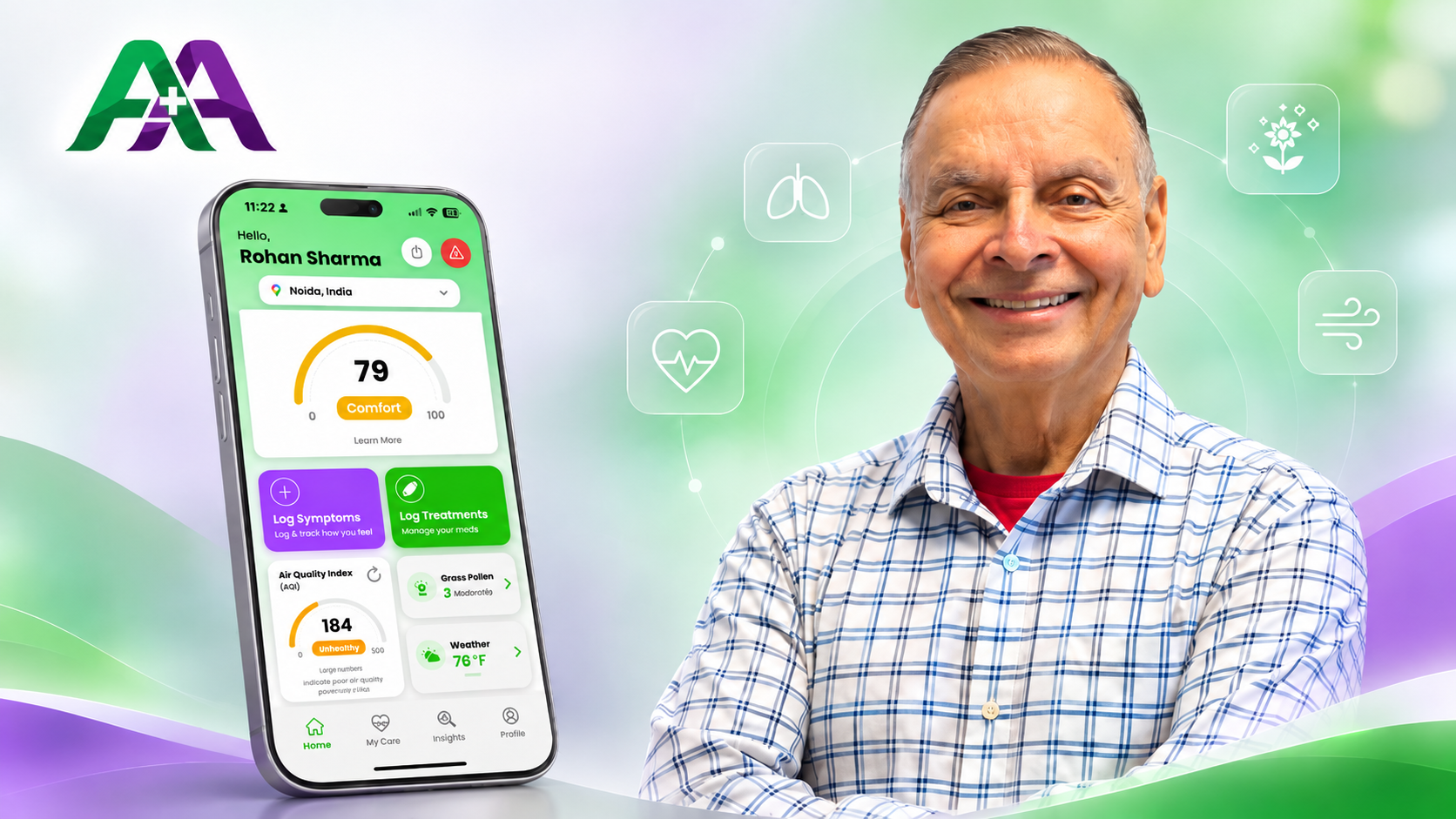
His newest work for India is AllerAid+, a free mobile app designed to make checking the air as routine as checking the weather, in any city. It also changes what you are looking at when you check.
Most people check the AQI, and it is a useful number. But it is built to describe the day, not the hour. For PM2.5, India’s official AQI is a running 24-hour average, so the most recent hour makes up only about one twenty-fourth of it, and the scale stops at 500. A sudden change in the air shows up in the index slowly, over the following hours.
AllerAid+ shows live readings of the Air Quality Index, PM2.5 and PM10 for each place you save, so you can see the particles in the air as well as the index. On Diwali night, the PM2.5 reading at Delhi’s Nehru Nagar station between 9 and 10 pm was 812 µg/m³, while the station’s official AQI read 387, an index averaged over the preceding 24 hours.
Both numbers have their place. The official AQI tells you about the day. A live reading tells you about the air you are stepping into now.
Wahi suggests three habits for the months ahead:
• Know the air where you actually are: Save home, your child’s school and an elderly parent’s house, even in another city, to see live AQI, PM2.5 and PM10 readings for each. City-wide figures can hide neighbourhoods and towns that are far worse, as this Diwali showed.
• Decide before you step out: The app sends alerts when air quality changes or pollen levels rise at the places you’ve saved, and colour-codes AQI levels so they can be read at a glance. A choice about a morning walk, an open window or outdoor play can be made in seconds.
• Keep a record: A built-in daily diary lets families note how they feel and compare it with pollen, weather and air quality data over the following weeks, a useful log to share with a doctor.
On the worst days, his advice is practical rather than alarming: keep windows closed during the most polluted hours, move exercise and yoga indoors, and watch children and older family members closely. Anyone with breathing difficulties should follow their doctor’s guidance.
“I grew up in Delhi, but my concern is for every Indian family breathing this air, in Lucknow, in Ludhiana, in Pune,” Wahi said. “I cannot clean the country’s air. What I can do is help people see it clearly, every day, and make better choices for the people they love.”
About Ashok Wahi
Born in New Delhi in 1950, Ashok Wahi studied at Mother’s International School, DAV College in Chandigarh and Thapar Institute in Patiala before earning an M.S. in Operations Research from New York University in 1976. He is the founder and president of Trutek Corp., which he runs with his wife, Neelu, and his daughter Kanika, a biomedical engineer.
About Trutek Corp.
Trutek Corp. is a New Jersey-based intellectual property, research and product development company focused on consumer wellness and preventive technologies. AllerAid+ is free to download on Google Play and the App Store (https://getalleraid.com/). AllerAid+ is an informational tool and does not diagnose or treat any medical condition.
Air quality figures are from the Central Pollution Control Board as reported by Down To Earth, The Hans India, Business Today and Outlook India (including the Nehru Nagar example); source estimates are from the Decision Support System for Delhi; national figures are from IQAir’s 2025 World Air Quality Report.
COMMENTS