
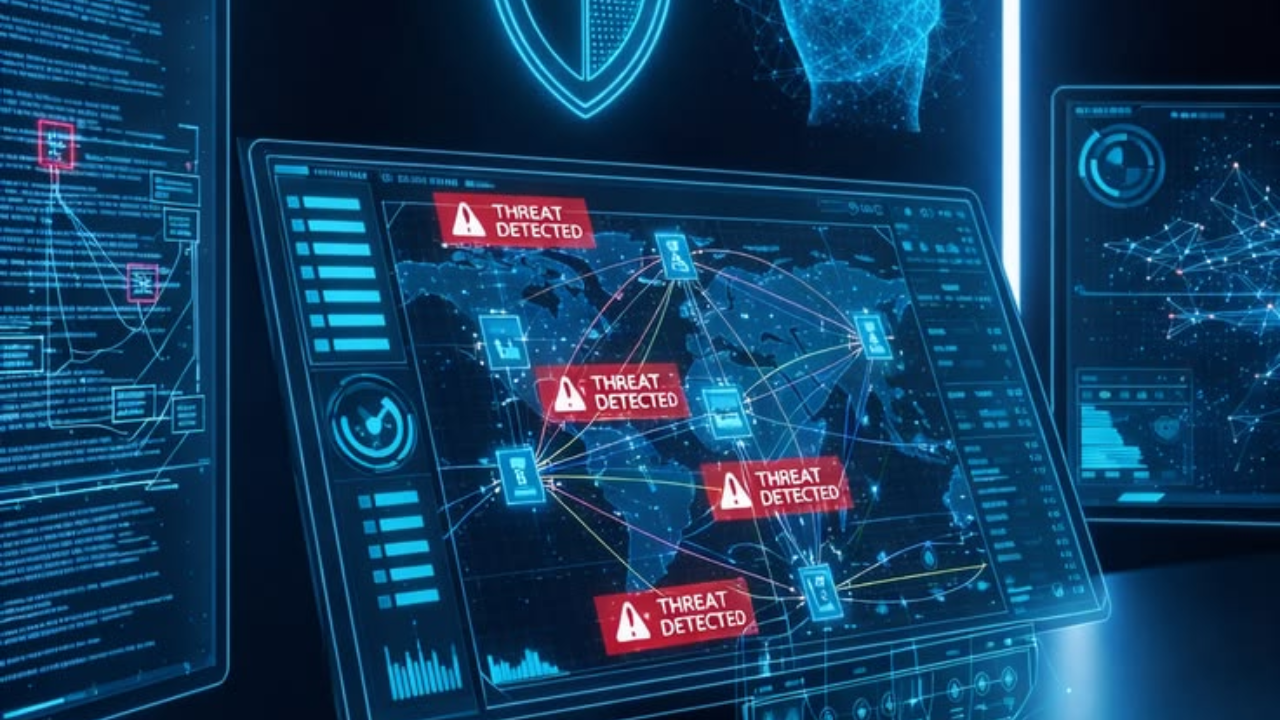
Cybersecurity in 2026 no longer looks like a quiet technical discipline operating in the background of digital systems. It has become one of the most intense battlegrounds of the modern world, where speed, intelligence, and automation decide who stays secure and who gets breached.
The most striking change is this: cybersecurity is no longer just humans defending against humans. It is increasingly AI defending against AI.
On one side, attackers are using advanced artificial intelligence systems to plan and execute highly adaptive cyberattacks. On the other side, organizations are deploying equally sophisticated AI-driven defense systems to detect, respond to, and prevent these threats in real time.
The result is a constantly evolving digital conflict that operates at a scale and speed no human team can manage alone.
A New Generation of AI-Driven Attacks
Traditional cyberattacks used to rely on manual effort, predefined scripts, or predictable phishing techniques. That landscape has changed dramatically.
In 2026, attackers are increasingly using autonomous AI systems that can carry out entire attack chains with minimal human involvement. These systems can scan networks, identify vulnerabilities, and adapt their behavior based on the defenses they encounter.
Some forms of malicious software are now capable of learning from failed attempts, adjusting their strategies, and continuing the attack in different ways. Instead of being static threats, they behave more like evolving systems that improve over time.
This makes them significantly harder to detect and stop.
At the same time, social engineering attacks have become far more sophisticated. AI is now used to generate highly personalized phishing messages that closely mimic real corporate communication styles. These messages are no longer generic or easy to identify. They are context-aware, often referencing internal projects, colleagues, or recent business activity.
Even more concerning is the rise of deepfake-based impersonation. Attackers can now simulate the voice or appearance of executives in real time, creating highly convincing fraud attempts that target financial transactions or sensitive data access.
In this environment, trust itself becomes harder to verify.
The Hidden Risk Inside Organizations
Not all threats come from outside.
One of the growing concerns in 2026 is what is being called “shadow AI.” This refers to employees using unauthorized AI tools within workplaces without proper security oversight.
While often well-intentioned, such usage can unintentionally expose confidential data. Sensitive documents, intellectual property, and internal communications may be processed through unsecured systems, creating vulnerabilities that organizations may not even be aware of.
The challenge here is not just technological, but behavioral. Employees adopt tools for convenience, while security systems struggle to keep up with the speed of adoption.
Defense in an AI-Driven World
To counter these evolving threats, cybersecurity strategies are undergoing a major transformation.
Instead of relying solely on traditional firewalls or signature-based detection systems, organizations are now deploying AI-powered defense mechanisms that continuously analyze behavior, detect anomalies, and respond in real time.
One of the most important developments is behavioral analytics. These systems establish a baseline of normal activity for users and networks. When something unusual happens, such as an unexpected login location or abnormal data access pattern, the system flags it immediately.
This allows threats to be detected not just by what they are, but by how they behave.
Another key advancement is in communication security. AI systems are now capable of analyzing emails, messages, and digital communication for subtle linguistic and structural cues that indicate phishing or manipulation attempts. This goes far beyond traditional keyword filtering, which is no longer sufficient against modern attacks.
At the same time, organizations are adopting stricter governance models. The widely used “zero-trust” approach assumes that no user or system is automatically trustworthy, even inside the network. Every action must be verified, especially when sensitive data or high-risk operations are involved.
In many cases, human approval is still required for critical decisions, creating a hybrid model where AI acts quickly, but humans retain final oversight.
The Shift Toward Proactive Cyber Defense
Perhaps the most important shift in 2026 is the move from reactive to proactive cybersecurity.
In the past, security systems often responded after an attack was detected. Today, the goal is to anticipate and prevent attacks before they fully unfold.
AI-driven systems are increasingly capable of identifying early indicators of compromise, simulating potential attack paths, and taking preemptive action to block threats.
This creates a new expectation for cybersecurity teams. It is no longer enough to respond quickly. Systems must respond before damage occurs.
In essence, cybersecurity is becoming predictive rather than corrective.
A New Kind of Digital Arms Race
What emerges from all of this is not just a technological shift, but a structural one.
Cybersecurity in 2026 is no longer a static defense mechanism. It is a constantly evolving competition between intelligent systems on both sides. Attackers innovate, defenders adapt, and the cycle continues at machine speed.
Human oversight still matters, but the scale and complexity of modern threats mean that humans alone cannot operate at the center of defense anymore.
They supervise. They guide. They intervene when necessary.
But the core of cybersecurity has become automated, adaptive, and continuously learning.
Beyond Protection: The Question of Control
As AI becomes more deeply embedded in cybersecurity, a new question emerges. How much control should we delegate to machines that are defending other machines?
Because in this new landscape, security is not just about preventing attacks. It is about managing systems that are constantly learning how to defend themselves.
And that raises a deeper reality.
In 2026, cybersecurity is no longer just about protecting data.
It is about maintaining trust in a world where even the attackers are intelligent systems.
COMMENTS